Beyond the Dashboard: Unpacking the Two Myths of Supply Chain AI
Scroll to find out more
Scroll to find out more

For the past few decades, the global consensus was simple: optimise supply chains for cost and efficiency above all else. Strip out inventory, extend supplier networks to wherever labor was cheapest, and rely entirely on just-in-time delivery. Financially, it worked – until it didn’t.
The crises impacting supply chain over recent years (the pandemic, the Suez Canal blockage, the Red Sea disruption, and huge tariff overhauls) are typically described as “black swans”. But if we’re honest, we can actually consider these to be predictable consequences of a system designed to be fragile.
Today, we are seeing a big shift. Recent history has proven that freight demand is remarkably inflexible. When shipping costs spiked 1,000%, businesses didn’t stop shipping. Afterall, you can’t sell what hasn’t moved. Macro costs like these are absorbed into the supply chain which effectively means that optimising for the cost of production and logistics is a game of diminishing returns. And your competitors are on the exact same treadmill as you, taking the same cuts on margin.
Because of this, the modern market differentiator is no longer cost; it is timing, agility, and having the right product in the right place, at the right time – before your competitors.
But as leaders scramble to build this agility, they are running into a problem; the technology market has created two misleading myths that are preventing shippers from unlocking real operational resilience:
Let’s unpack both.
Every supply chain software provider today will promote AI as a magic bullet. However, while research shows that true AI-led supply chains deliver roughly 23% greater profitability, only 23% of supply chain teams have a formal AI strategy, and a mere 9% use AI widely.

This gap exists because the market has narrow-mindedly packaged AI as a visibility tool. Most digital platforms stop the moment they tell you a container is sitting at a port – but tracking a delay after the fact isn’t a strategy.
To put it simply, visibility alone gives you a front row seat to disruption but no recommendations or ability to do anything about it. True AI in supply chain isn’t about passive observation; it’s about giving shippers three things which, together, enable true resilience:
The data problem facing shippers is two-fold: data needs to be integrated across systems, and also interconnected with the external factors which shape global shipping.
For the shippers we speak to every day, critical information is often trapped in multiple systems and files, captured inconsistently, and completely disconnected from the outside signals that dictate what happens next. Teams spend more time reconciling data sources than actually analysing them.
True AI-driven visibility doesn’t just mean adding another dashboard; it means consolidating years of structured operational data into a single source of truth so your systems can learn.
Knowing your shipment is delayed or your cargo ready date is missing isn’t a strategy.
Precision is the difference between modeling a reroute in minutes or convening a planning team for a day of meetings; it means delivering an intuitive customer experience which delights and makes a true difference to your brand.
An AI-native infrastructure applies predictive logic to forecast outcomes using live and historic data combined, calculating port congestion likelihood, refining ETA windows, and sharing early warnings about demand shifts before they become crises.
Even when insights emerge, the path from insight to execution remains slow and manual. An alert lands in an inbox, someone escalates it, a meeting is scheduled, a spreadsheet is built and, by the time a decision is finally made, the opportunity to act has been and gone.
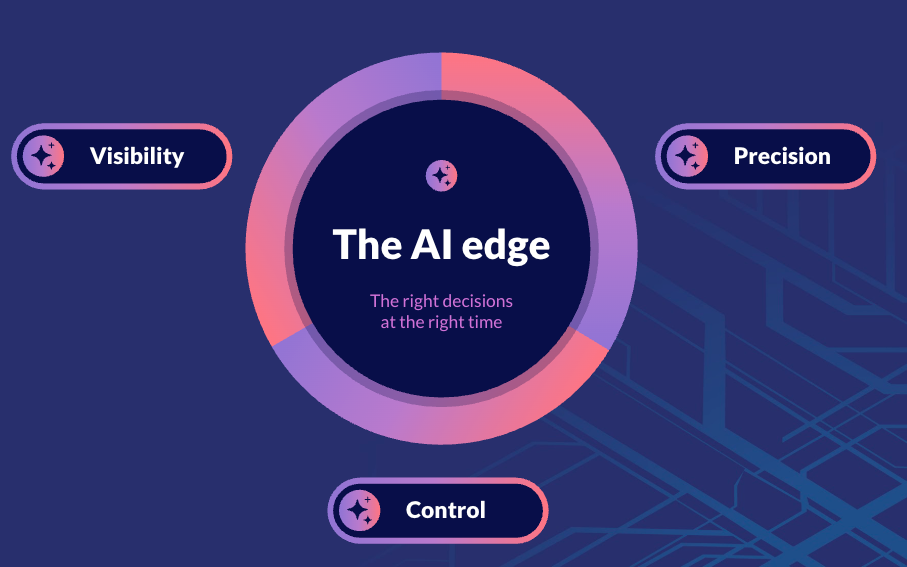
Control means having a system capable of prescriptive and autonomous logic. Rather than simply flagging a disruption, it immediately surfaces your best options, calculates the financial impact, and empowers you to execute the fix instantly.
The demos we see today from standalone platform providers show a clean, easy workflow – what we call the “happy path”, where every shipment is smooth and data flows seamlessly. However, for teams living in market updates, spreadsheets, and PDFs, the “happy path” simply doesn’t exist. The truth is, shippers need AI capable of spanning the entire operational spectrum: automating and smoothing out business-as-usual tasks, such as supplier CRD chasing, while simultaneously modeling macro disruptions like sudden tariff overhauls or geopolitical shifts.
Simply put, standalone software delivering simple visibility is great when everything goes right, but it breaks down entirely when confronted by the messy reality of global logistics. This reality exposes the second misconception.
Platform providers will try to convince you that, with a shiny dashboard providing total visibility of your shipments, your days will run smoothly. But the truth is, a standalone software tool cannot redirect a container, negotiate spot rates during a crisis, or untangle a customs bottleneck at 2AM – at least, not without a human-in-the-loop who understands the nuances of your business and supply chain.
When software companies with little experience in the physical supply chain world build tools, they create detached systems that break down the moment they hit the chaotic reality of global freight operations.
To gain a true competitive edge, shippers don’t just need a tool. They need a freight forwarding partner powered by an intuitive, AI-native platform – a platform built by supply chain experts, for supply chain experts.
True control requires an operational model where software and freight forwarding experts live under one roof. When a logistics team works inside the exact same system as the shipper, the platform handles the data processing – automating workflows, flagging delays—while the physical forwarding team handles the execution. The technology identifies the disruption early, freeing up human operators to reroute the container, untangle customs, and ensure that digital insight translates into a real-world solution on the ground.
Supply chains used to be invisible infrastructure – the plumbing of global commerce that few thought about until something went wrong. The last five years have changed this permanently; supply chains are now a strategic asset.
Utilising data to trim your freight bill is just the base case. The real prize of an AI-powered supply chain is gaining the agility to know what your customers actually want before your competitors do, and getting the goods there. The businesses that will pull ahead aren’t necessarily the biggest or best-resourced. They’re the ones with the best data, the right operational partner, and the mindset to move quickly when the data tells them to act.

In Focus: A network in transition The return to the Suez Canal is gathering pac...
In Focus: Record orders meet record-tight capacity The container orderbook-to-f...

In Focus: Capacity in flux as Suez recovers and Panama tightens The Suez Canal...