Middle East conflict: Freight Market Update
Scroll to find out more
Scroll to find out more

Last updated: Thursday 5th March 2026
This bulletin will continue to be updated with the latest developments. Please check it regularly for the latest updates and recommendations.
Geopolitical tensions in the Middle East have escalated rapidly over the past few days. While the immediate disruption is centred in the Gulf, carrier and insurer responses show that risk perception has shifted across global freight markets.
This update summarises where things stand today and what it means for shippers and supply chains.
Operational caution across Gulf and Red Sea corridors has continued to shape global freight networks over the past week. All five major container lines including Maersk, MSC, CMA CGM, Hapag-Lloyd, and COSCO officially suspending or halting transits through the Strait of Hormuz and are instead rerouting vessels via the Cape of Good Hope. Carriers are maintaining risk-mitigation measures including selective booking controls, contingency port planning and continued application of war-risk and fuel-related surcharges.
Insurance premiums for transits in high-risk zones remain elevated, contributing to rising voyage costs and reinforcing the persistence of longer routings on some services. Several Asia–Europe loops that had tentatively planned partial Suez returns are now holding Cape of Good Hope deployments in place pending greater security clarity. This is extending effective transit times and tightening available vessel capacity across connected trades.
In air freight, restricted overflight permissions and longer routings continue to reduce effective payload and aircraft utilisation on Asia–Europe corridors. Sea–air solutions routed via Gulf hubs remain operational but constrained.
From a market perspective, these developments are beginning to feed into rate sentiment. While demand recovery post-Chinese New Year remains uneven, sustained network inefficiency is creating upward pressure on spot pricing and increasing schedule variability.
Shippers should continue prioritising lead-time resilience, routing flexibility and early capacity engagement as geopolitical risk remains a key driver of freight market behaviour.
For a deeper operational view of how the Middle East conflict is reshaping global freight networks, you can watch our on-demand briefing with Zencargo CEO Richard Fattal, where we unpack carrier responses, capacity impacts and what supply chain leaders should prepare for next.
Hapag-Lloyd has introduced contingency procedures for shipments already in transit to and from Upper Gulf destinations, including the UAE, Saudi Arabia, Kuwait, Qatar, Bahrain, Iraq, Oman and Yemen.
The carrier has advised that vessels may delay port calls, remain in safe waters, or divert to contingency ports depending on operational and security conditions. Cargo already moving through the network may therefore experience schedule disruptions or extended transit times.
For shipments that have not yet been loaded, export bookings may be cancelled or suspended, with containers already gated into terminals required to be retrieved by customers where loading has been halted.
Hapag-Lloyd has confirmed that war-risk surcharges remain in effect, and that additional operational costs, including storage, handling or rerouting charges, may apply depending on how cargo is handled under contingency procedures.
The carrier has also indicated that if alternative instructions are not received for affected cargo, an End-of-Voyage declaration may be issued, with cargo discharged and stored at an alternative location pending further arrangements.
MSC has introduced additional war-related surcharges across several trade lanes in response to the escalating security situation around the Strait of Hormuz and Bab el-Mandeb.
The carrier has confirmed that an Emergency War Surcharge (EWS) will apply to cargo moving from the Indian Subcontinent (India, Pakistan, Sri Lanka and Bangladesh) to East Africa, Somalia, Mozambique and Indian Ocean island destinations.
In a separate advisory, MSC has also introduced a War Risk Surcharge (WAR) for cargo moving from the Arabian Peninsula (including the UAE, Saudi Arabia, Oman, Qatar, Kuwait, Bahrain and Iraq) to West Africa, East Africa, South Africa, Mozambique and Indian Ocean island destinations.
Both surcharges are effective from 5 March 2026 (gate-in date) until further notice. The WAR surcharge will be applied at the following levels:
MSC has stated that the measures reflect the growing operational risk and disruption to maritime traffic in the Strait of Hormuz and Bab el-Mandeb corridors, and that the situation continues to be monitored closely.
Maersk has introduced precautionary operational measures across several Gulf trades following its latest risk assessment.
The carrier has temporarily suspended new cargo bookings to and from the UAE, Oman (except Salalah), Iraq, Kuwait, Qatar, Bahrain, and Saudi Arabia (Dammam and Jubail) until further notice. The suspension applies to cargo originating from, destined for, or transshipping through these countries.
Reefer, dangerous and special cargo acceptance to and from the affected Gulf ports has also been suspended.
Maersk confirmed that Jeddah and King Abdullah (Saudi Arabia) and Salalah (Oman) remain operational at this stage.
For cargo already in transit, the carrier indicated that some shipments may be rerouted or temporarily stored within the region to maintain operational stability and avoid congestion at key hubs.
Maersk added that airspace closures across several Gulf states are reducing flight options, which may extend transit times and limit Sea–Air connectivity through the region.
MSC has issued an “End of Voyage” declaration for cargo destined for Arabian Gulf ports. The measure applies to shipments currently under MSC’s custody, including cargo already at sea or ashore, destined for ports across the UAE, Qatar, Saudi Arabia, Kuwait, Bahrain, Oman and Iraq.
Under this declaration, vessels currently en route to the Gulf will divert to the nearest safe port of discharge. Cargo will be offloaded at those locations and made available to customers for local recovery or onward transport arrangements.
MSC has also confirmed that a mandatory USD 800 per container surcharge will apply to affected shipments to cover deviation costs, with additional discharge-related handling, storage and recovery expenses remaining the responsibility of the cargo owner.
This directive reflects a further escalation in operational precaution measures affecting Gulf routings and reinforces the broader shift in carrier behaviour currently emerging across the region.
CMA CGM has confirmed that emergency operational measures are now in place for shipments to and from multiple Gulf destinations, including the UAE, Saudi Arabia, Qatar, Kuwait, Bahrain, Oman and Iraq.
The carrier has indicated that vessels may divert to contingency ports where required due to the evolving security situation. Cargo discharged at those locations will be placed at the customer’s disposal, with onward transport arrangements — including inland delivery or change of destination — to be confirmed following discharge.
CMA CGM has advised that these measures are being implemented under the force majeure provisions of its Bill of Lading, with any related costs arising from diversion, handling, storage or onward transport remaining for the account of the cargo.
Hapag-Lloyd has implemented a booking stop for cargo to and from multiple Upper Gulf destinations, including the UAE, Iraq, Kuwait, Qatar, Bahrain, Oman (Sohar), Saudi Arabia (Dammam and Jubail) and Yemen.
The measure has been introduced with immediate effect due to operational and security constraints in the region and will remain in place until further notice. The carrier has indicated it will continue to monitor the situation and provide further updates as conditions evolve.
OOCL has confirmed that its fleet is currently remaining outside the Persian Gulf as a precautionary measure in response to the evolving security situation in the region.
The carrier has implemented a safety protocol under which no OOCL-operated vessels will enter the Persian Gulf or approach within 200 nautical miles of the Strait of Hormuz without prior approval. This measure is intended to ensure the safety of crews, vessels and cargo while the situation continues to be monitored.
OOCL has also indicated that it is assessing alternative arrangements for affected cargo, including potential alternative discharge ports where required, and will provide further updates as operational conditions evolve.
Yang Ming has confirmed that cargo acceptance has been suspended on certain Middle East services following recent developments in the region. Existing bookings may experience schedule delays or routing adjustments, with updates to be provided as operational conditions evolve. Cargo acceptance will remain paused until further notice.
Yang Ming has advised that operations on certain Middle East services and ports are impacted, with cargo acceptance currently suspended on affected services. Existing bookings may experience schedule delays or route adjustments, with further updates to be provided as operations resume.
CMA CGM has suspended all new bookings with immediate effect and until further notice for cargo loading or discharging in the following locations:
The carrier has stated this is a precautionary measure to safeguard crew, vessels, and cargo.
Airspace closures across parts of the Middle East continue to disrupt commercial flight operations, with key Gulf hubs operating under significant restrictions. Limited services are beginning to resume in some areas, but full scheduled operations remain constrained.
In the United Arab Emirates, Emirates, flydubai and Etihad Airways have restarted a small number of flights primarily for repatriation and aircraft repositioning from Dubai and Abu Dhabi. Wider commercial schedules remain subject to airspace clearance.
In Israel, Ben Gurion International Airport is reopening in a highly restricted format, initially focused on Israeli-operated flights and scaling gradually as conditions allow.
Several European and Asian carriers continue to suspend or reroute services, with some operating via longer alternative corridors, including Caucasus and Saudi/Egyptian routings where permitted.
In limited cases, alternative regional connectivity is emerging. Wizz Air has increased frequencies to Sharm el-Sheikh, and Air India Express has resumed services to and from Muscat, though wider Gulf routes remain suspended.
From a cargo perspective, reduced access to Gulf hubs continues to limit effective capacity across Asia–Europe corridors and constrain Sea–Air options. Volatility remains elevated.
Monday 2nd March:
Over recent days, military escalation in the Middle East has prompted precautionary operational responses across key maritime and aviation corridors in the Gulf region.
Several ocean carriers have suspended transits through the Strait of Hormuz and paused Suez Canal routings on affected services, while airspace restrictions across parts of the Middle East have led to flight cancellations and rerouting.
What began as a regional security development is now influencing carrier routing decisions, insurance posture, and capacity deployment across global freight networks.
Several Asia–Europe services that had recently resumed Suez Canal transits are now reverting to Cape of Good Hope routings following the latest carrier directives.
This reverses earlier routing adjustments and increases overall voyage distance across affected strings.
On Asia–North Europe and Asia–Mediterranean trades, services that had reinstated Suez passages have withdrawn those routings, and previously announced structural returns within alliance networks have been paused.
For Transpacific services between Asia and the U.S. East Coast, the direct impact is more limited, as most loops were already avoiding Suez.
Carrier responses have now progressed beyond monitoring statements into operational directives:
| MSC | Declared End of Voyage for Gulf-bound shipments. Cargo en route will divert to the nearest safe port for discharge. USD 800/container deviation surcharge applied. Additional war-related surcharges introduced across ISC and Arabian Peninsula trades. WAR surcharge up to USD 3000 / 40ft (USD 4000 reefer) effective 5 March. |
| Maersk | Hormuz crossings suspended. Booking acceptance paused for UAE, Oman (except Salalah), Iraq, Kuwait, Qatar, Bahrain and Saudi Arabia (Dammam/Jubail). Reefer and dangerous cargo acceptance suspended. Some cargo in transit may be rerouted or temporarily stored in the region. |
| CMA CGM | Has suspended all new bookings for most Gulf ports and instructed Gulf-bound vessels to shelter, while continuing to suspend Suez Canal passage. |
| Hapag-Lloyd | Booking stop for Upper Gulf cargo and contingency procedures for shipments already in transit. Vessels may hold in safe waters or divert to contingency ports; war-risk and operational surcharges apply. |
| OOCL | OOCL-operated vessels currently remaining outside the Persian Gulf. Entry into the Gulf or within 200 nautical miles of the Strait of Hormuz requires prior approval. |
| Yang Ming | Cargo acceptance suspended on affected Middle East services, with potential schedule delays and routing adjustments. |
While these actions are precautionary, they will materially impact network confidence and vessel deployment.
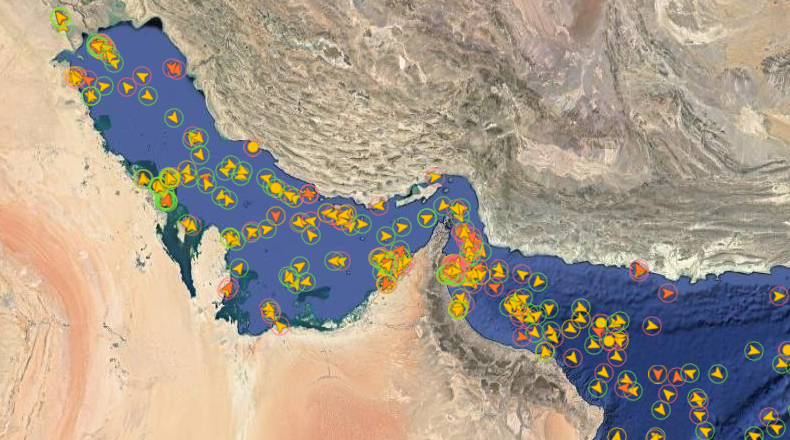
While trades that do not transit near or through Middle-Eastern corridors are continuing to operate, extended voyage distances and precautionary shelter directives may influence wider network balance if disruption persists.
Longer rotations can reduce effective capacity and extend equipment repositioning cycles. Where cargo is discharged outside planned loops, transshipment hubs such as Salalah or Khor Fakkan may experience additional volume, which can introduce variability into schedule reliability across connected services.
The disruption is not confined to the ocean. Airspace restrictions across parts of the Middle East have triggered cancellations and rerouting. Gulf-based carriers (including Emirates, Etihad, and Qatar Airways) are among the most affected, as a significant proportion of their fleets operate via key Middle Eastern hub airports. Constraints across these hubs are therefore having an outsized impact on global air cargo connectivity.
Reduced capacity, longer routings, and redeployment of aircraft are introducing volatility into Asia–Europe air freight markets. Sea–air solutions routed via Middle Eastern hubs are also becoming less viable in the near term.
Even lanes not directly tied to the region may experience secondary tightening as aircraft and crews are repositioned across longer and more fuel-intensive routes.
If instability continues, we would expect to see:
This is not solely a Gulf origin/destination issue; global shipping is, by its very nature, interconnected. Adjustments in one region can quickly influence equipment balance and reliability across global loops.
As of today, there is no immediate direct disruption to our core Asia–North Europe or ISC–North Europe flows. However, the risk of second-order effects is elevated.
Shippers should consider:
Periods of geopolitical volatility also tend to accelerate conversations around resilience. Alternative routing strategies and rail options may become more relevant if uncertainty remains prolonged.
Confirmed carrier shelter instructions and booking suspensions increase the probability of wider network effects if disruption persists. At present, the impact on our core lanes remains manageable. We are monitoring carrier advisories, insurer signals, and booking behaviour in real time. Where exposure exists, our teams are engaging customers directly with tailored guidance. We will continue to provide structured updates as clarity develops.
Global freight markets are currently operating in a period of heightened geopolitical uncertainty. Recent developments in the Middle East may introduce short to mid-term volatility across certain transport corridors and carrier networks. While the precise impact cannot be predicted at this stage, carriers may implement operational adjustments such as schedule changes, service rerouting or conflict-related surcharges. As these measures are determined directly by carriers and authorities, they may arise with limited notice and cannot be reliably forecast within current rate structures.
As part of our approach to long-term partnership, Zencargo remains closely connected to carrier networks and market developments across the regions in which our customers operate. We will continue to monitor the situation closely and, where changes arise, provide proactive communication and as much advance visibility as possible, to support planning and decision-making.
Given the evolving nature of the situation, we believe it is important to flag this potential market volatility at the outset. Our focus will remain on maintaining transparency and providing clear guidance as conditions develop.
This bulletin will continue to be updated with the latest developments. Please check it regularly for the latest updates and recommendations.

In Focus: Container backlog surpasses 2022 peak The major operational risk acro...

In Focus: Rhine hits record lows as China works through typhoon backlog Two sep...

The India-UK Comprehensive Economic and Trade Agreement (CETA) came into force...