
Episode 31:
Navigate - 2023:
It's time to take action
See all episodes
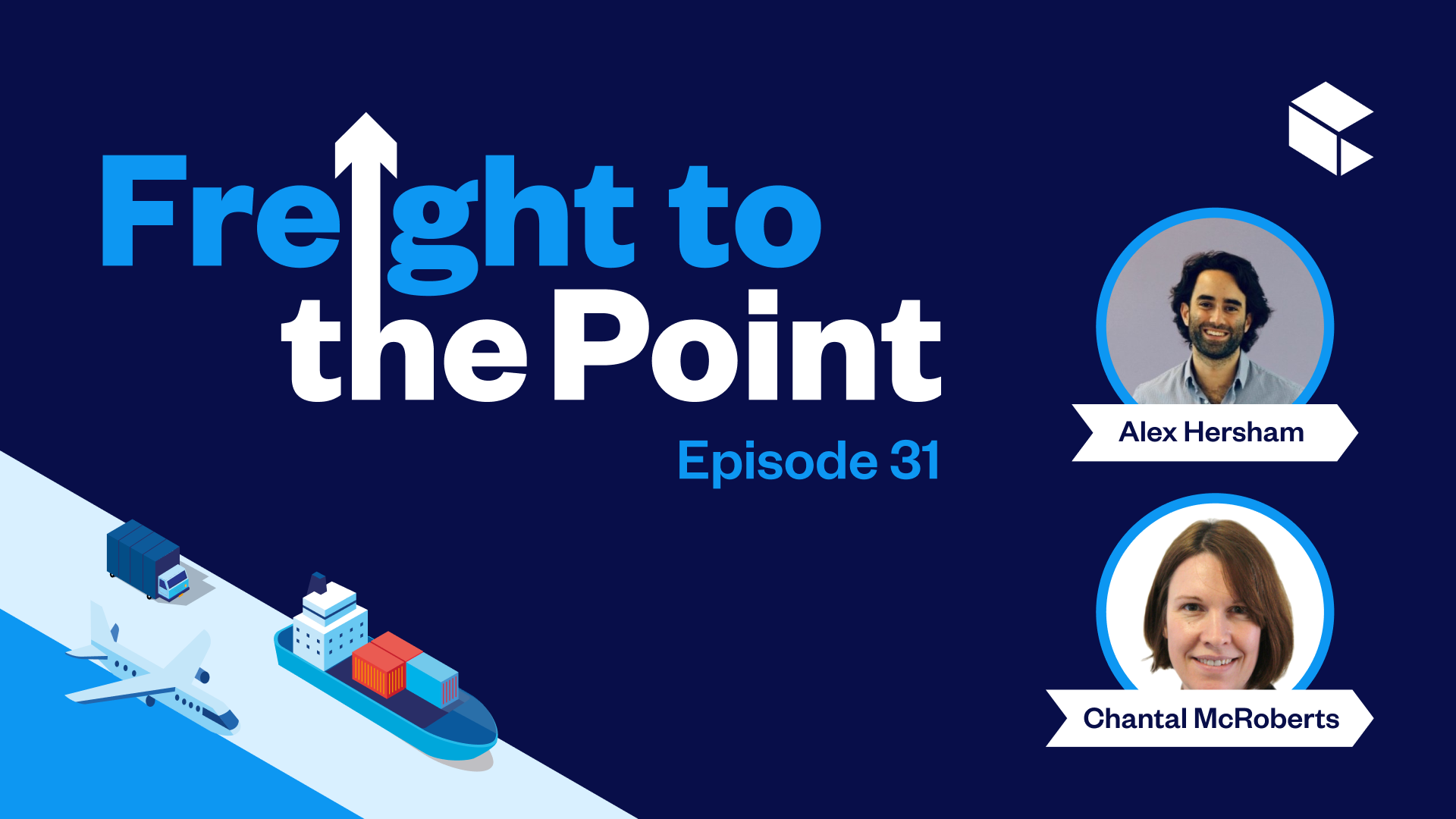

“The industry is entering a period of managed decline. So capacity management will be key to determining what the freight levels are.”
This week, we have another special episode as we’re featuring a throwback to one of our Navigate sessions in October, ‘2023: It’s Time to Take Action’. In this session, Alex Hersham and Chantal McRoberts, Head of Advisory at Drewry Shipping Consultants talk about what shippers need to do when heading into 2023.
They discuss:
- How shippers are currently navigating the market
- What shippers need to do when it comes to contract negotiations
- How to become a shipper of choice
Chantal McRoberts
With over 20 years of experience in the maritime and container shipping industry, Chantal McRoberts has worked for a range of companies including P&ONedlloyd, APL and Maersk in trade management and operational roles. As Head of Advisory at Drewry Shipping Consultants, Chantal is a qualified project manager and oversees core deliverables for bid events and advisory work.
Resources
- How to become a shipper of choice
- Navigate – Why now is the time to diversify your rate strategy
- Balancing risk and opportunity during tender season
 Hello and welcome to another episode of Freight to the Point, a podcast from Zencargo. I’m Helena Wood. And today we have another special episode where we feature one of the recorded sessions from our virtual summit Navigate, which we last held back in October. The session featured today was titled, ‘2023, It’s Time to Take Action’, with Zencargo’s CEO and co-founder Alex Hersham and Chantal McRoberts, the head of advisory at Drewry Shipping Consultants. In their session, Chantal and Alex covered what has happened in the market, how shippers should navigate contracting season for 2023, and why businesses should not forget about origin management amidst the falling freight rates.
 Welcome Chantal and welcome back to Navigate everyone. I’m delighted to be joined by Chantal Roberts, who’s the head of advisory at Drewry. Chantal has over 20 years of experience in the maritime and shipping industries. She started off working at P&0, which I recently found out where she was the youngest ever trade manager, which is a really fun fact. Now, Chantal was modest and said it was for a backhaul trade, but I think backhaul trades are really the lifeblood of how businesses work. And Chantal’s worked at some other startups, like APL and Maersk, so is very au fait with the in and outs of how shipping lines work. And Chantal’s going to be talking to us about what’s happening in the market, how we as a community and you as shippers can prepare for 2023 tender season. And I think importantly will also be talking to us about what does it mean to be a shipper of choice in today’s market? And is that relevant in today’s market? I think it is very relevant, but Chantal will be telling us more. Welcome Chantal.
 I’m sure they are and I’m sure they’re very much looking forward to hearing less of me and more of you. So I’m going to jump right in, if that’s okay? This is probably the obvious starting question, but the market is moving very, very quickly. Tell me how your clients are keeping up with these changes.
Really lots there and lots to digest. We’re going to come onto the 2023 tender season and what you’re seeing with some of the large players and how the wider audience can read into that in a moment. And we’ll also talk about this concept of being shipper of choice and the relevance in today’s markets. But you touched on there a few things. Without going into any details, what are you seeing where dead freight deals have been signed? Is there any room for negotiation there or if a dead freight deal has been signed it’s been signed?
And do you see any carriers trying to merge that conversation into a 2023 conversation? Obviously, some dead freights are multi-year anyway.
But is that happening? So are we having 2023 negotiations almost happening by accident already, because of that type of dead freight contract renegotiation or not?
I think you have to put it in the context of where you think the market’s going to go. In our opinion, we think the industry is entering a period of managed decline. So capacity management will be key to determining what the freight levels are and where do they bottom out and where do they normalise? So that destocking conversation fits within that. Obviously that is happening right now, but we know there’s a weaker outlook for demand. So when you put the combination of those together, even if we hit a point where people need to then rebuild inventory, demand is lower and consumer spending is lower. So therefore the volumes will therefore be lower, which means the capacity available will be higher, which then again drives down that supply/demand balance. So it really is thinking about the context of the market, where it might go the rest of this year and where it might go next year and how both of those things fit into this.
And I think that point of relationships are important, is a really apt point. And I’m going to come on now to this question around being shipper of choice. But I think if we look to the last 24 months, and I know not everyone has acted in the same way, but actually relationships have been very vital, whichever way we look at it, whether it’s allocation, whether it was equipment release, whether it was at the beginning of the crisis, even being offered a long term deal was seen as preferential. So I totally agree with that. You have spoken though, many times about being shipper of choice, the importance of choosing the right shipping line. Talk to us about the relevance of that, given the backdrop of this falling market.
So I actually really agree with that and I think I obviously definitely agree with straightforward of choice, let’s start with that. But I also really agree with shipper of choice and knowing who you want to do business with. Some shipping lines are more flexible and more supportive and more relationship oriented. Some preferred data, some are okay with let’s say, more volatile or transactional relationships, I think that’s really important. And I think despite the fact that we might look back over the last 18 to 24 months and say, “Well, rates have been high, maybe now it’s our turn.” Type dynamic. I think having relationships through the cycle is vital and it really helps businesses perform. Just before you joined, Helena was saying that there was a poll done and people are still expecting a lot of uncertainty and a lot of volatility. And again, if you can build those ties and deepen those relationships across the ecosystem, I think that helps you navigate and buffer through those periods of uncertainty quite effectively.
Well, all we have to do is look back to a period not too long ago when there was the Suez Canal blockage with the Ever Given. And I remember that the days and weeks before that, it really did feel like the market was coming down, I don’t know if you recall. But it really felt like the term market was getting back down to a three or even a two handle. You could feel it getting to an elevated but only marginally elevated level. And then obviously, that completely changed the game and sustained very, very high levels for the following 12 months really. And I’m not saying that was the only thing that drove it, but if we think about that in the context of it was one thing that acted as a big catalyst to change structurally the outlook. Again, I think it speaks to the importance of relationships and the importance of both sides to the table delivering on what they said they were going to deliver on.Talk to me for a little bit about origin management, because I know that this is a service that Drewry had been offering recently. And at Zencargo, just for context, we think that purchase order management is key. We think that if you do purchase order management well the skew visibility that it gives you is so powerful for your merchandising colleagues. The ability to drive down origin dwell times, which is one of the key KPI’s I actually look at on a daily basis in terms of how we operate our business, it’s hugely impacted by doing purchase order management. Consolidation and reducing the amount of air freight all impacted by great PO management that for us flows through our systems, but we have the network on platform. But you’ve been speaking to me a lot about origin management and how Drewry think about origin management. So perhaps maybe I can start with why have you recently started to offer services around origin management?
Yeah, I think it’s a cost leakage point. I also just continue to believe that it’s one of the biggest strategic levers that if done well can impact the entire downstream. Obviously doing things at destination to manage destination dwell, to manage prioritisation of intake, to understand if there’s been service disruptions and what that means for intake are all hugely important. But we start at Zencargo really with the belief that purchase order management when done well is a game changer and only a few businesses globally do it well. And the impact of that can have. Actually, if I talk a bit about what I see in the market, we even see such a big divergence in how people manage origin dwell. So everybody wants to focus on the origin dwell KPI. Rarely, unless you’re working with businesses like Zencargo, do you actually have accurate data. Because typically, the manufacturer might say it was the freight forward or the freight forward of the manufacturer, the shipping line might jump in as well. So there’s always that dynamic.But also it’s so interesting how people manage their origin in different ways. Some are happier to have longer cash to cash cycles and flow everything through a CFS even if it doesn’t need to flow through a CFS, so they have more control over their intake and they store more at origin. Others are more about lead times and processing and if you can find utilisation improvements then that’s great but never crush the lead times. So really I think there’s so much value across origin management. And maybe there’s some people out there that we can support together, you through the consultancy service and us through the ongoing order management and I think that would be a lot of fun.I’m conscious of time and I know that I’ll be brow beaten into making sure that we move through. So just a couple of last quick fire questions to you. The first one, is the market going to stabilise?
Very interesting. I’m going to move us on, if that’s okay, Chantal to some Q and A? So I definitely can’t answer this first question, because it’ll be the definition of talking my own book. The first question is essentially if I can summarise, is around large shipping lines moving more and more into end to end. We’ve obviously seen that with CMA while ago, acquiring Ceva and then them going on to do more in contract logistics. We’ve seen it with Maersk, obviously with their several acquisitions. You could say to an extent we’ve recently seen it with both Hapag and MSC, although they might argue that that was more one off and they’re more focused on still being the world’s best shipping lines rather than going direct.To an extent we’ve seen it with Cosco as well, although to a much lesser extent. And obviously, this has triggered a lot of MNA as a result. The question really is are these large ocean carriers ready, paraphrasing here, to handle these volumes directly with shippers? Are they well set up? And do we see a large migration of business going forward as to shipping lines? And then if I can build on that, as the rates normalise, does that trend, if it is a trend, does it continue next year, because maybe a big part of the leverage was the rates they were able to offer? So your thoughts on that would be much appreciated.
So candidly, if you were advising clients next year and Maersk offering this integrated service, obviously it will come down to the end to end cost and the value and the technology, and what it can drive, but is it something that you’d be advising clients to shy away from given what you’ve heard or a different piece of advice?
And do you feel, because there’s another comp question that just came in asking, where do you expect Asia and Europe to go to? It’s hard to tell, because it’s obviously moving very quickly. Are you able to share anything there?
Yeah. And it’s very difficult. And then there is one last question here. Talking about the divergence of this year across in the market right now with rate levels moving quite dramatically. What we’ve been seeing is that it really does depend on how full carriers are right now and how they feel about their position. I’m curious what you are seeing, but we do see quite a big deviation from some carriers there. But I think it’s going to start to compress, but at least in the past month or two, which is probably quite a unique period in the economic cycle, but I think it will start to reconverge in terms of the dislocations that we’re seeing on a rate level. Is that consistent with what you’ve seen?
Thank you so much for your time. The last thing that I’ll say before leaving is, this really does remind me a lot of what happened in 2008, 2009, 2010. And I remember CSAV really getting very excited about the market. And actually in hindsight that was all because of restocking and so we’ll speak about that later. But I think it’s important for everyone on this call to think about might we go through that cycle again? And therefore, again, it comes back to your point about shipper of choice, relationships, origin management, and the value, but also navigating this market environment. So Chantal, thank you very much. And Helena, I’ll hand it back over to you.
Thank you for tuning into another episode of Freight To the Point. If you liked this week’s episode, don’t forget to like and subscribe to our podcast. And please do reach out to us on LinkedIn if you have any feedback or questions or if you would like to suggest a future Freight to the Point episode. Thank you.
Episode 72: The Red Sea Crisis
In the latest episode of Freight to the Point, we’ve featured our most rec...
Episode 71: The potential of demand forecasting with artificial intelligence
In the most recent instalment of Freight to the Point, Lucie Phillips, Zen...

Episode 70: Rates: What's next for 2024?
As we prepare for the year ahead, it's crucial to consider the three pillars...