Premature Peak: Navigating the Summer Capacity Crunch
Scroll to find out more
Scroll to find out more
The ocean shipping peak has come early this year, with Drewry’s World Container Index reaching an 18-month high in mid-June, climbing more than 20% in a fortnight as Asia-Europe and Transpacific demand surged simultaneously. Other data confirms rates spiking after the 1 June general rate increases and peak season surcharges took hold. Accordingly, the US National Retail Federation has moved its peak month forecast forward from July to June.
The spike is being driven by tariff-driven frontloading on the Transpacific, fuel-cost anticipation on Asia-Europe, and an underlying capacity environment with virtually no flexibility to absorb either. Here we’ll examine market conditions, carrier strategy and conditions lane-by-lane to help you plan.
Alphaliner data shows the commercially idle container fleet sitting at 0.7% of global capacity, meaning that there is simply no spare space to redeploy.
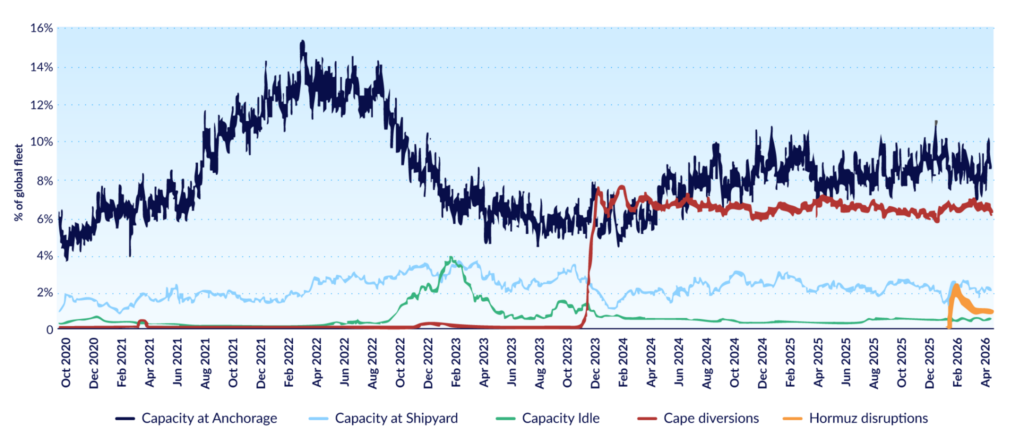
Adding in the roughly 310,000 TEU of vessels that have been diverted, sheltered or had transponders deactivated in response to Hormuz disruption and the picture tightens further. Ongoing Red Sea diversions, with Asia-Europe traffic still routing around the Cape of Good Hope, continues to absorb effective capacity through longer sailing times.
The result is a rate increase resulting organically from market conditions, rather than any strategic plan. Drewry’s most recent count showed just three blanks on the Asia-Europe lane in the week ending 21 June.
Reports of a US-Iran interim agreement, still in negotiation at time of writing, with the Strait of Hormuz reopening within thirty days, have improved market sentiment, But a full return of traffic is expected to take months, and rate pressure has now shifted from fuel-driven to demand-driven.
Carriers are managing a genuinely difficult capacity environment, and the standard responses are all visible at scale:
Carriers are also adding selective extra loader sailings to relieve pressure on the tightest services, particularly out of China and Southeast Asia. These are tightly managed and haven’t broadly eased space availability, but they do indicate that carriers are trying to increase capacity where they can.
For shippers, the practical implication is that those with forward agreements are best positioned to navigate the squeeze. For most, working through a freight forwarder such as Zencargo with established carrier partnerships and consolidated buying power is one of the most effective ways to secure both, particularly for shippers without the scale to negotiate directly.
While a high level view of the market shows consistent rate rises from tight capacity, the precise dynamics driving developments vary lane-by-lane, which will influence how long the peak lasts and the opportunities on each lane.
Global container fleet deployment by trade

The US-China tariff truce announced in May triggered a wave of imports as shippers raced to bring in inventory during the ninety-day window before the tariffs potentially return.
For retailers looking to move products from China to the US, advance booking of three to four weeks is now the minimum on most Transpacific services.
Shippers on the Asia-Europe lane are accelerating cargo ahead of the 1 July bunker adjustment, with Freightos reporting that fuel surcharges are expected to jump roughly 80% when the quarterly BAF updates. Drewry’s mid-June reading showed Shanghai-Rotterdam and Shanghai-Genoa rates both climbing more than 15% week-on-week.
The IDC lane is experiencing a different version of the same squeeze. Middle East cargo has been actively rerouted through Indian ports since the Middle East conflict began, creating sudden demand spikes on services that weren’t built for that volume.
Looking ahead, capacity on this lane could tighten further if carriers redeploy vessels out of the region to serve more lucrative Far East services as peak season builds.
The squeeze is likely to persist through Q3.
Our upcoming webinars will cover the early peak dynamics on the Transpacific and Asia-Europe trade lanes. Register now to secure your space and receive the recordings to watch on-demand.
To learn how we can support your business to stay ahead of the changes, talk to one of our team.

In Focus: Capacity in flux as Suez recovers and Panama tightens The Suez Canal...

Chief Revenue Officer at Zencargo, Sam Greenhalgh, and VP Operations & Fina...
In Focus: Container backlog surpasses 2022 peak The major operational risk acro...